


Your Complete Guide to Warehouse Jobs in London
Navigate the logistics capital of the UK. Find immediate start roles, secure competitive pay, and build a rewarding career.
Explore Warehouse & Logistics Roles
London's vast distribution network offers diverse opportunities. Whether you're seeking an immediate start or a path to management, understand the landscape.
The London Warehouse Job Market
As a global hub for e-commerce, retail, and manufacturing, London boasts one of the most dynamic logistics sectors in Europe. Major distribution centres in areas like Park Royal, Dagenham, and Croydon are constantly seeking reliable staff. The demand for warehouse jobs in London remains consistently high, offering stability even in fluctuating economic times. Many roles, especially for Warehouse Operatives and Pickers and Packers, offer immediate start dates, perfect for those seeking quick entry into the workforce.
This sector is not just about manual labour. Modern warehouses are technology-driven environments. Familiarity with Warehouse Management Systems (WMS), RFID scanners, and automated picking systems is increasingly valuable. Salaries are competitive, often including shift allowances for nights and weekends, and there are clear progression routes into team leadership, inventory control, and logistics coordination.
From Entry-Level to Specialist Positions
- Warehouse Operative/Assistant: The backbone of the warehouse. Duties include loading/unloading vehicles, moving stock, and general housekeeping. No experience is often required, making it a perfect starting point. Explore our dedicated page for Warehouse Assistant roles.
- Picker/Packer: Responsible for accurately selecting items from shelves (picking) and preparing them for shipment (packing). Speed and accuracy are key. Attention to detail is crucial for this role.
- Forklift Operator: A licensed specialist role with higher pay. Requires certification (e.g., Counterbalance, Reach Truck) to safely move palletised goods. We can help you find roles like Forklift Operator Jobs in Cricklewood.
- Inventory Clerk/Controller: Focuses on stock accuracy, cycle counting, and reconciling discrepancies. This role requires strong organisational skills and often involves data entry.
- Shift Supervisor/Team Leader: Manages a team of operatives, ensures safety protocols are followed, and meets productivity targets. Requires prior experience and leadership qualities.
How to Land Your Ideal Warehouse Role
There are two primary pathways: direct applications to large logistics companies or using a specialised agency. For most candidates, especially those seeking immediate start positions, partnering with a reputable recruitment agency is the most efficient method. They have established relationships with major employers across London and can often place you within days.
A good agency doesn't just fill vacancies; they provide career guidance. This is similar to how building services recruitment agencies specialise in facilities and maintenance roles, or how one might search for agencies for virtual assistant near me for remote admin support. For front-of-house positions, one might look for a receptionist job London through a hospitality-focused agency. In logistics, a specialist agency understands the unique demands of shift work, safety certifications, and the fast-paced environment. For a deeper dive into this process, read our Complete Guide to Warehouse Recruitment Agencies.
Why Pursue a Warehouse Career in London?
Immediate Start & High Demand
The logistics sector has a constant need for staff. Many employers offer roles that start within the week, providing quick access to income. Our portal lists Immediate Start Warehouse Jobs in London updated daily. This demand mirrors other urgent staffing needs across the city, such as for Part-Time Immediate Start Jobs in other sectors.
Clear Career Progression
Variety & Flexible Scheduling
housekeeping sector in hotels or front of house roles in hospitality, which also offer varied shifts.
Pro Tip: Stand Out in Your Application
Highlight any experience with manual handling, teamwork in a fast-paced environment, or adherence to health and safety procedures—even from unrelated jobs. Reliability and a strong work ethic are often valued more than specific warehouse experience for entry-level roles. For your CV, quantify achievements where possible (e.g.,"Consistently met daily picking targets of 150+ items with 99.8% accuracy"). Preparing for your job search is as crucial as it is for finding a Receptionist Job in Custom House or any other competitive position.
Navigating Your Warehouse Job Search
Key London Warehouse Locations & Employers
London's warehouse landscape is decentralised, with major clusters in specific industrial areas. Knowing these hubs can help you target your search and minimise commute times.
- West London (Park Royal, Greenford, Perivale): A massive logistics park serving central London and the M4 corridor. Home to major retailers, food distributors, and third-party logistics (3PL) companies.
- East London (Dagenham, Barking, Thurrock): Close to the London Gateway port and with excellent motorway links (M25, A13). Ideal for import/export, bulk storage, and manufacturing support.
- South London (Croydon, Purley Way, Mitcham): Features a mix of older industrial estates and newer developments, serving South London and Surrey with a focus on retail and parcel distribution.
- North London (Enfield, Edmonton, Wembley): Key areas for white goods, building materials, and fashion logistics. Well-connected to the North Circular and M1.
Major employers include giants like Amazon, DHL, UPS, Royal Mail, as well as supermarket chains (Tesco, Sainsbury's) and countless specialist 3PL providers. Opportunities are also abundant in surrounding regions, similar to the demand seen for Immediate Start Warehouse Jobs in Birmingham.
Essential Skills & Certifications for 2024
While many entry-level positions require no formal qualifications, possessing certain skills and certifications will make you a more attractive candidate and open doors to higher-paying roles.
Core Soft Skills
- Reliability & Punctuality: The absolute #1 requirement for shift-based work.
- Teamwork: Warehouses run on coordinated effort.
- Health & Safety Awareness: Understanding of basic manual handling techniques and a commitment to a safe workspace.
- Adaptability: Ability to handle different tasks as priorities change throughout a shift.
Valuable Certifications
- Forklift Truck License (RTITB/NORS): The most impactful certification for increasing pay. Covers Counterbalance, Reach Truck, and Pedestrian Stacker.
- Manual Handling Certificate: Often provided on the job, but having it beforehand is a plus.
- Fire Safety/Marshal Training: Demonstrates proactive responsibility.
- First Aid at Work: A highly regarded qualification in any industrial setting.
Day in the Life: What to Expect
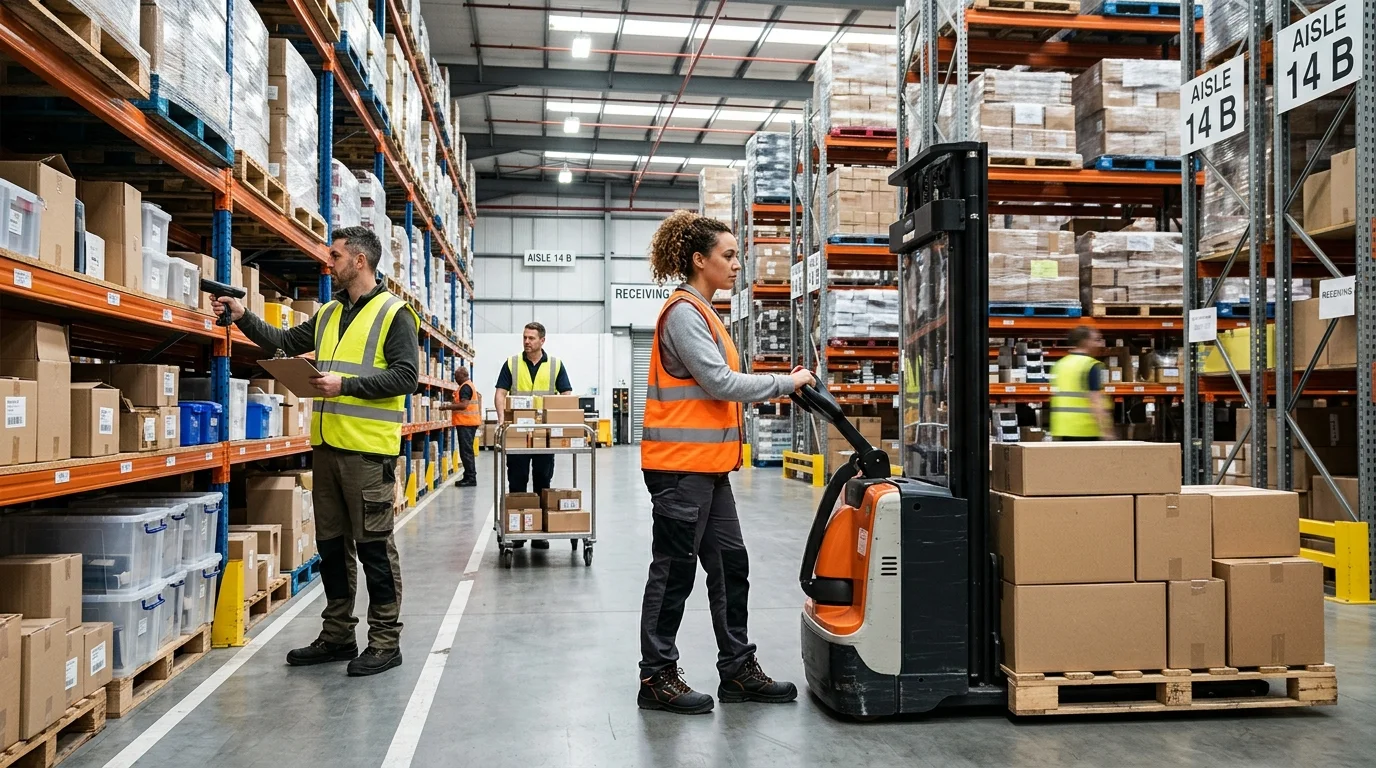
A typical shift for a Warehouse Operative or Picker/Packer starts with a team briefing (a"toolbox talk") covering the day's targets, safety reminders, and any special instructions. You'll then be assigned a zone or task. The work is physically active and requires focus—whether you're scanning items, driving a pallet truck, or building safe pallets for dispatch. Breaks are scheduled, and safety wear like steel-toe boots and hi-vis vests are mandatory. The environment is often busy and can be noisy, but it's also structured and team-oriented. For those who enjoy active, tangible work where you can see the results of your effort at the end of each shift, it can be incredibly satisfying. This hands-on nature is shared with other vital support roles, such as those in Events Set-Up and Break-Down or facilities teams.
AI Video Placeholder
"A 60-90 second timelapse video showing a"Day in the Life" of a warehouse operative in a modern London distribution centre. Show the start-of-day briefing, the variety of tasks (picking with a handheld scanner, pallet moving, packing station work), team interactions, and the end-of-shift cleanup. Convey a sense of energy, teamwork, and structured process."
Frequently Asked Questions
For most basic operative, picker, or packer roles, no specific prior experience is required. Employers primarily look for reliability, a positive attitude, physical fitness for manual handling, and the ability to work well in a team. Any previous work experience that demonstrates these traits (e.g., in construction, retail, hospitality, or cleaning) is highly valuable. Agencies often provide brief on-the-job training for specific systems.
Pay varies by role, shift pattern, and specific employer. As a guide (2024): Entry-level Operatives/Pickers can expect £11-£13 per hour. Forklift Operators typically earn £13-£16+ per hour. Night shifts and weekend work usually command a premium (an additional £1-£3 per hour). Many roles also offer paid breaks and overtime opportunities, which can significantly increase weekly take-home pay. Always check the specific job listing for the advertised rate.
A recruitment agency acts as your advocate and matchmaker. They have access to a wider range of unadvertised roles and can submit your CV to multiple employers simultaneously. They will often pre-interview you, advise on your CV, and brief you on the employer—increasing your chances of success. They also handle payroll for temporary contracts, ensuring you get paid correctly and on time. This is similar to the service provided by Cleaning Recruitment Agencies or building services recruitment agencies in their respective fields. For a direct application portal, visit our main Warehouse Jobs UK page.
Both are widely available. Many employers use temporary-to-permanent contracts. You start on a temporary basis (often through an agency) for a trial period, typically 12 weeks. If you perform well and the business has ongoing needs, you are frequently offered a permanent contract directly with the company. This is a common pathway and a low-risk way for employers to find the best long-term staff. Permanent roles are also advertised directly, especially for experienced candidates or specialist positions.
Ready to Start Your Warehouse Career in London?
Stop searching and start working. Our specialist team connects you with reputable employers across the capital, from immediate start temporary roles to permanent career positions. Whether you're an experienced forklift operator or looking for your first role in logistics, we're here to help.
We also specialise in Comprehensive Staffing Solutions for businesses across London and the UK.
Salary Breakdown & Financial Benefits
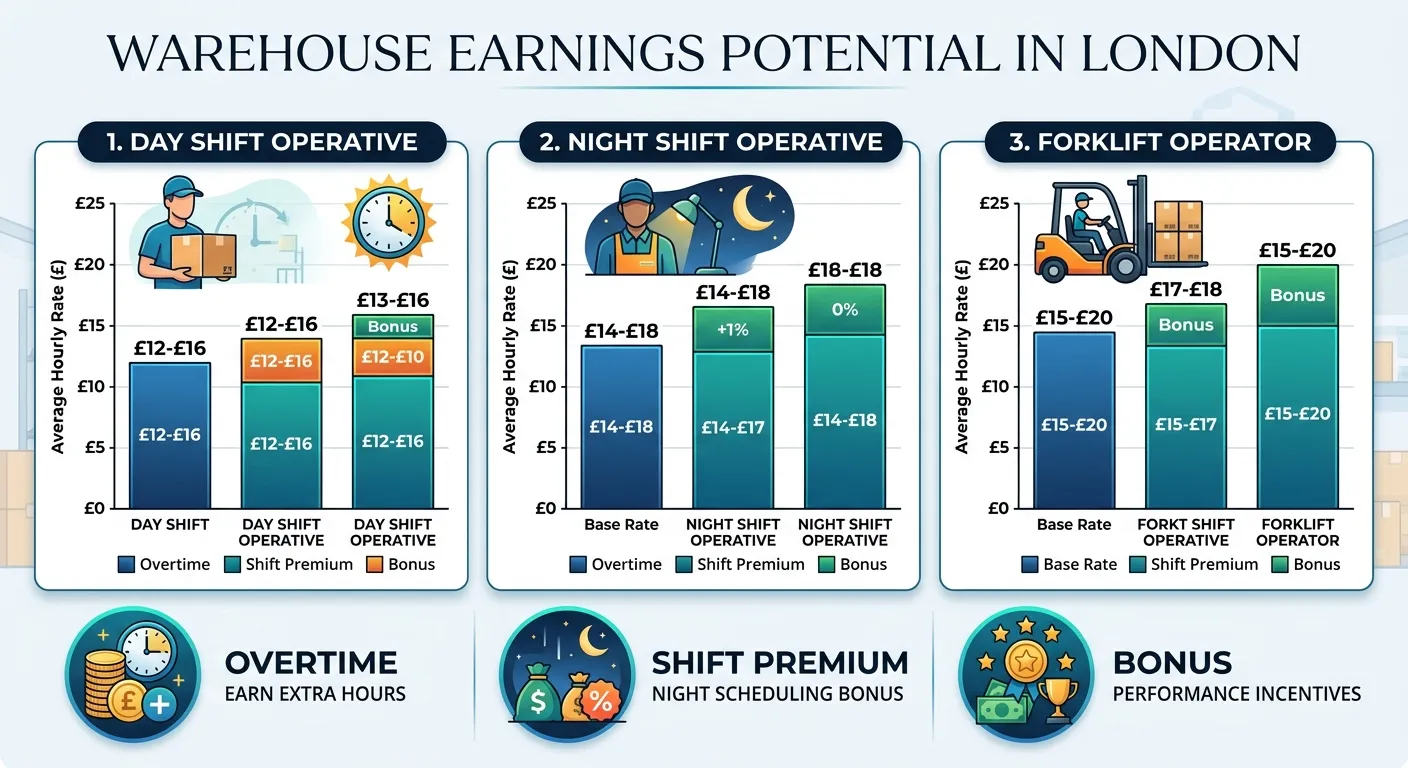
Understanding the full compensation package is crucial. Beyond the base hourly rate, warehouse roles in London often include financial benefits that significantly boost your earnings. Shift premiums are standard, with night shifts (typically 10pm-6am) adding 15-25% to your pay. Weekend work, especially Sundays, often comes with enhanced rates or"double-time" for certain employers.
Overtime is frequently available, especially during peak seasons like Black Friday, Christmas, and summer sales. Many companies offer performance-based bonuses for teams that exceed picking targets or maintain perfect safety records. Some larger corporations also provide pension schemes, cycle-to-work schemes, and employee discounts with major retailers.
Real-World Earnings Example:
A Forklift Operator on a permanent night shift (Sun-Wed, 10pm-8am) could earn: Base rate of £14.50/hr + Night shift premium of £2.50/hr = £17.00/hr. A 40-hour week grosses £680. With occasional overtime, monthly take-home pay can comfortably exceed £2,200 after tax and NI.
Comparing Role Types
-
Agency Temp
Higher hourly rate, flexible, no long-term commitment. Ideal for testing different employers. Holiday pay accrued separately.
-
Temp-to-Perm
Starts as agency temp. After successful trial (often 12 weeks), move to permanent contract with company benefits (pension, sick pay).
-
Direct Permanent
Greatest job security. Full benefits package from day one. Often requires proven experience or specialist skills.
The Tech-Driven Warehouse: Skills for the Future
Today's distribution centres are far from the dusty storage spaces of the past. They are sophisticated, technology-intensive operations. Familiarity with these systems is a major career advantage.
Key Systems & Equipment
-
Warehouse Management Systems (WMS)
The digital brain of the operation. You'll likely use a handheld RF scanner or wearable device that connects to the WMS, telling you exactly what to pick, where to put it, and tracking your productivity in real-time.
-
Automated Guided Vehicles (AGVs) & Robotics
In larger fulfilment centres, robots bring entire shelving units to picking stations. Understanding how to work alongside this automation—replenishing stations, clearing jams, and performing basic troubleshooting—is a valuable skill.
Case Study: From Picker to Process Champion
"I started as a seasonal picker at an Amazon fulfilment centre in Dagenham. I was curious about the scanners and asked my manager how the system decided my route. He showed me the basics of the WMS logic. I volunteered to help train new starters. Within 18 months, I was promoted to an 'Ambassador' role, responsible for onboarding and process improvement. I'm now training for a shift assistant manager position."
— Mark R., Process Champion
This path highlights a key trend: technical aptitude and curiosity are now as important as physical stamina. Employers increasingly seek operatives who can interact with complex systems, report technical issues accurately, and adapt to software updates.
Staying Safe & Healthy on the Job
Warehouse work is active and rewarding, but it carries inherent risks. Reputable employers prioritise safety above all else. Understanding these protocols protects you and your colleagues.
- ✓ PPE is Non-Negotiable: Steel-toe boots (often provided via an allowance), hi-vis vests, and sometimes gloves or safety glasses must be worn at all times on the floor.
- ✓ Manual Handling Training: You will be trained to lift correctly—bending knees, keeping back straight. Never attempt to move something that feels too heavy; always use mechanical aids or ask for help.
- ✓ Pedestrian & Vehicle Segregation: Strict zones for forklifts and pedestrians. Always use designated walkways, be aware of your surroundings, and make eye contact with drivers.
- ✓ Reporting is Key: You have a duty to report any near-misses, damaged equipment, or hazards (like spills or blocked fire exits). A good safety culture encourages this.
Beyond Physical Safety: Wellbeing Matters
Shift work, especially nights, can impact your sleep and social life. Successful warehouse workers develop strong routines:
- Sleep Hygiene: Blackout curtains, white noise machines, and a consistent sleep schedule are essential for night workers.
- Nutrition & Hydration: Pack healthy meals and snacks. Avoid heavy, greasy foods before or during a shift. Stay hydrated—many warehouses provide water stations.
- Physical Recovery: Use rest days properly. Stretching, light exercise, and proper rest prevent burnout and repetitive strain injuries.
- Utilise EAPs: Many larger companies offer Employee Assistance Programs (EAPs)—confidential, free services offering financial, legal, and mental health support.
Beyond the Basics: Specialist Career Paths
Once you have foundational experience, you can branch into niche areas that offer higher pay, more responsibility, and unique challenges.
Cold Storage & Ambient Logistics
Working in temperature-controlled environments for food, pharmaceuticals, or chemicals. Requires tolerance for cold (chiller: 0-5°C, freezer: -20°C or below) and strict adherence to hygiene protocols (often requiring special PPE). Pay is typically 10-15% higher than ambient roles.
Specialist PPE Higher PayHazardous Goods Handling
Warehousing flammable, corrosive, or toxic materials. Requires specific ADR (European Agreement concerning the International Carriage of Dangerous Goods by Road) awareness training. Roles are highly regulated, detail-oriented, and command a significant salary premium due to the specialist knowledge and risk involved.
ADR Training High ResponsibilityReturns & Reverse Logistics
A growing sector driven by e-commerce. Involves processing customer returns—assessing condition, deciding if items can be resold, repackaged, or need recycling. Requires good decision-making skills, customer-centric thinking, and often data entry. It's less physically demanding than inbound/outbound but requires high levels of accuracy.
E-commerce Growth Problem-SolvingThese specialist paths demonstrate that warehouse careers are not dead-ends. They are gateways to skilled, technical, and well-compensated professions within the broader supply chain ecosystem. For those interested in the coordination side, skills gained here are a perfect stepping stone to Logistics Coordinator roles.
Your 5-Step Action Plan to Secure a Role
Knowing the landscape is one thing; taking structured action is another. Follow this practical plan to move from searching to starting.
Audit & Enhance Your CV
Tailor your CV specifically for logistics. Beyond listing previous jobs, create a"Warehouse-Relevant Skills" section. Highlight metrics:"Manually handled 200+ parcels per shift,""Maintained 99.9% picking accuracy,""Trained 3 new team members on the MHE." Use action verbs like 'coordinated,' 'dispatched,' 'reconciled.' Ensure your contact details are prominent and you have a professional email address. A generic CV might suffice for a Kitchen Porter role, but warehouse recruiters look for specific indicators of resilience and process understanding.
Pro Tip: If you lack direct experience, reframe other work. Retail stockroom duties, event setup, and even moving house demonstrate manual handling and teamwork. State your willingness to complete any required certifications (e.g., Manual Handling) immediately.
Choose Your Recruitment Partners Wisely
Register with 2-3 agencies that specialise in industrial and logistics recruitment. Look for agencies with strong Google reviews and physical offices in your target areas (e.g., East London). Prepare for a thorough registration process: you'll need proof of right to work (passport, biometric residence permit), National Insurance number, and bank details. Be honest about your availability, shift preferences, and any physical limitations. A good agent will match you to suitable roles, not just any vacancy. This relationship is as crucial as the one you’d build with a specialist Office Manager agency for corporate roles.
Prepare for the Assessment & Interview
Many large logistics companies use a two-stage process: a practical assessment followed by a competency interview. The assessment may involve a basic numeracy test (checking order numbers), a short manual handling demonstration (lifting a box correctly), and a simulated picking task. For the interview, prepare STAR (Situation, Task, Action, Result) examples around teamwork, working under pressure, and adherence to safety. Research the company—are they a retail giant, a third-party logistics provider, or a specialist cold chain operator? Your questions should reflect this:"What are the main KPIs for this role?" or"Can you describe the team culture on the night shift?"
Understand the Onboarding Process
Once you accept an offer, onboarding is swift but thorough. You will undergo mandatory training, often paid. This covers site-specific safety induction, fire evacuation, manual handling, and sometimes system training for their WMS. You'll be issued with PPE. Use this period to absorb everything—ask questions. The first few shifts will likely pair you with a mentor or 'buddy.' This is your chance to learn the unwritten rules and build relationships. Remember, probation periods (typically 12 weeks) are a two-way street; you're also assessing if the role and company are right for you.
Plan for Long-Term Growth from Day One
Don't wait a year to think about progression. In your first month, identify the top performers and leaders. What do they do differently? Express your career interests to your supervisor early:"I'm keen to get my forklift license in the future, what's the best path here?" or"I'm interested in the inventory control team." Volunteer for extra training if offered. Document your achievements and positive feedback. Building a reputation for reliability and initiative is the fastest track to promotion, much like excelling in a Hotel Concierge role can lead to front office management.
London's Warehouse Sector: Trends Shaping 2024 & Beyond
Sustainability & The Green Warehouse
Environmental responsibility is no longer a niche concern. Major developers and occupiers are investing heavily in sustainable distribution centres. This includes:
- ▶ EV Charging Hubs: Fleets of electric forklifts and delivery vehicles require infrastructure. Roles related to maintaining this tech are emerging.
- ▶ Solar-Powered Units: Large rooftop solar arrays are common on new builds, reducing grid reliance and operational costs.
- ▶ Waste & Recycling Management: Stringent waste segregation roles are becoming more specialised, moving beyond general housekeeping.
Candidates who show awareness of these initiatives demonstrate forward-thinking, a quality valued by progressive employers. This shift is parallel to the growing demand for green skills in sectors like Building Services and facilities management.
Data Analytics & The"Smart" Operative
The WMS generates vast amounts of data on productivity, travel paths, and inventory turnover. The next evolution is using this data proactively. Future-facing roles may include:
Case Study: Predictive Replenishment
"At a fashion retailer's DC in Croydon, experienced pickers noticed recurring stockouts in specific size ranges during peak times. By collaborating with the inventory team and analysing pick data, they helped develop a 'hot pick' alert system that triggers automatic replenishment from bulk storage when fast-moving items dip below a threshold. This reduced walking time and increased overall shift efficiency by 8%."
Takeaway: The ability to interpret system data and suggest process improvements blurs the line between operative and logistics analyst.
Your Pre-Start Checklist & Essential Resources
🛒 Before Your First Shift
- Footwear: Invest in quality steel-toe cap safety boots. Comfort is critical—you'll be on your feet for 8-12 hours.
- Transport Plan: Test your commute at the actual shift time. Many industrial estates have poor public transport links late at night.
- Documents: Have your right-to-work doc, NI number, and bank details ready for payroll setup.
- Hydration & Nutrition: Purchase a durable water bottle and prepare lunchbox ideas that are energising and easy to eat.
📚 Further Learning & Support
To deepen your knowledge and advance your career, explore these resources:
- Free Online Courses: Platforms like FutureLearn and the Chartered Institute of Logistics and Transport (CILT) offer introductory modules on supply chain fundamentals.
- Government-Funded Training: Check for local"Skills for Life" or adult education budgets that may fund forklift licenses or health and safety certifications.
- Union Membership: Consider joining a union like Unite or GMB for collective bargaining on pay/conditions, legal support, and career advice specific to the logistics sector.
- Networking: Follow key logistics employers and recruiters on LinkedIn. Engage with content to stay informed about industry news and new site openings.
Your journey in London's dynamic logistics sector starts with a single step. With preparation, the right support, and a proactive mindset, a warehouse role can be the foundation of a stable and progressive career.
Get Personalised Career Advice TodayIn-Depth: London's Major Logistics Hubs & Their Specialties
Each industrial corridor in London has developed its own logistical identity, shaped by transport links, land availability, and historical tenant mix. Understanding these nuances can help you target roles that align with your interests and expertise.
The Thames Gateway: Port-Centric Logistics
Stretching from Dartford through Thurrock to Dagenham, this area is defined by its deep-water ports (London Gateway, Tilbury) and vast, modern distribution parks. The work here is often large-scale and international.
- Typical Roles: Container unloading/stuffing, customs documentation support, HGV loading for national distribution, bulk commodity storage.
- Employer Profile: Global shipping lines (Maersk, MSC), major 3PLs like XPO Logistics, and retailers with significant import volumes (e.g., B&Q, IKEA).
- Skill Emphasis: Understanding of port operations, experience with heavy-duty MHE (e.g., container handlers), and awareness of bonded warehouse procedures are major advantages.
The pace can be dictated by shipping schedules, leading to bursts of intense activity followed by quieter periods for inventory management. This environment suits those who enjoy large-scale, tangible logistics.
The M1 Corridor: The E-Commerce Engine
Areas like Milton Keynes, Hemel Hempstead, and Watford, while outside Greater London, are integral to its supply chain. They host mammoth, highly automated fulfilment centres serving next-day and same-day delivery promises to the capital.
- Typical Roles: High-volume pick/pack, robotics station monitoring, returns processing, parcel sortation hub operatives.
- Employer Profile: Pure-play e-commerce giants (Amazon, ASOS, Ocado) and parcel carriers (DPD, Hermes/Evri, Yodel).
- Skill Emphasis: Comfort with relentless pace, ability to interact with multiple pieces of technology simultaneously, and resilience for high-pressure peak seasons.
Career progression here is often well-structured, with clear ladders from associate to ambassador, process guide, and into management, but it demands consistent metric performance.
The Human Factor: Building a Successful Warehouse Career
Technology and processes are vital, but warehouses run on people. The social and professional dynamics of a shift team significantly impact your job satisfaction and success.
Navigating Shift Culture & Team Integration
Each shift—days, backshifts (lates), and nights—develops its own distinct culture. Day shifts often have more management presence and cross-department interaction. Night shifts, while quieter managerially, foster a strong sense of camaraderie and independence; the team is responsible for hitting targets without direct oversight.
Integration Tip: In your first week, be proactive. Ask questions, offer to help colleagues during downtime, and participate in shift briefings. Avoid cliques. The reliability you demonstrate in your first month will define your reputation for years. Remember, a warehouse team's trust is earned through consistent action, much like in a high-stakes events crew where teamwork is safety-critical.
Real Talk: The Mentor-Mentee Relationship
"When I started on nights, my assigned buddy, Sarah, didn't just show me the scanner. She taught me the shortcuts—which aisles were drafty, when the hot water in the breakroom actually worked, and how to read the supervisor's mood from the morning email. That unofficial knowledge was priceless. Six months later, I was the buddy for a new starter. That cycle of knowledge is what makes a warehouse function smoothly." – Jamie, Shift Operative, Enfield.
Conflict Resolution & Communication on the Floor
In a high-pressure, physically demanding environment, minor tensions can arise—over shared equipment, perceived pacing differences, or miscommunication. Effective warehouse workers develop de-escalation skills.
- Direct, Respectful Communication: If a colleague's action creates a safety concern or hinders your work, address it calmly and privately. Use"I" statements:"I couldn't see you when you reversed from that blind spot."
- Utilise the Chain of Command: For persistent issues, speak to your team leader. Provide facts, not emotions. Good supervisors act as mediators.
- Formal Channels: For serious concerns (harassment, safety violations), all reputable companies have formal HR and reporting procedures. Know them.
Your ability to maintain professional relationships directly impacts team productivity and your own well-being. It’s a soft skill as valued as any technical certification.
Mastering Your Finances: A Shift Worker's Guide
The variable income from shift premiums and overtime is a benefit, but it requires disciplined financial planning. Moving from a fixed weekly salary to a variable one is a key adjustment for many new warehouse workers.
Budgeting on a Variable Income
The golden rule is to budget based on your base hourly rate for standard hours. Treat shift premiums and overtime as supplementary income. This ensures your essential expenses (rent, bills, groceries) are always covered, even in a quieter week.
- Calculate Your Base Monthly Income: (Hourly Rate x Standard Weekly Hours x 52) / 12. This is your foundation.
- Create an"Overtime & Premiums" Pot: Direct this extra income into separate savings accounts for specific goals: a"Car Fund,""Holiday Pot," or emergency savings.
- Leverage Technology: Use budgeting apps that allow for variable income. Allocate funds as soon as you receive your payslip.
- Plan for Annualised Hours: Some contracts have fewer guaranteed hours in January/February. Use your Q4 overtime earnings to create a buffer for this period.
This proactive approach prevents the cycle of"feast or famine" spending and builds long-term financial security from what can be a very well-paying career.
Understanding Your Payslip & Rights
Warehouse payslips can be complex. Key lines to understand:
- Basic Pay: Hours at your standard rate.
- Shift Allowance/Night Premium: A separate line item for enhanced pay.
- Holiday Pay: If you're a temp, this is often accrued and paid separately. Know your entitlement.
- Pension Contributions: Ensure you're enrolled if eligible (Auto-Enrolment).
Know Your Rights: You are entitled to rest breaks (usually 20 mins for a 6+ hour shift). Travel time between an agency's office and the site may not be paid. Always clarify this before accepting a role. For permanent staff, understand the company's sick pay policy beyond statutory pay.
Sustaining Performance: Managing Physical & Mental Load
Beyond Manual Handling: Injury Prevention
While training teaches you how to lift, long-term health requires a holistic approach. The most common issues are not acute injuries but repetitive strain: tendonitis in wrists from scanning, lower back fatigue, and knee stress.
- Pre-Shift Dynamic Stretching: 5 minutes of leg swings, arm circles, and torso twists increases blood flow and prepares muscles.
- Micro-Breaks: Use the few seconds between tasks to stretch your neck, roll your shoulders, and flex your feet.
- Footwear is Everything: Replace insoles every 6 months. Consider visiting a specialist shop for boots that address your gait.
- Cross-Training: Off-duty exercise should balance your body. Swimming, yoga, or cycling counteracts the constant standing and lifting.
Report any persistent ache or pain to your supervisor. Early intervention through physiotherapy or adjusted duties is standard in good companies and prevents a minor issue becoming a career-limiting injury.
Mental Resilience in a Repetitive Environment
The repetitive nature of picking or packing can be mentally challenging. Developing strategies to stay engaged is crucial for both performance and well-being.
- Task Variation: If possible, volunteer for different tasks—an hour on inbound, an hour on packing. The mental shift breaks the monotony.
- Gamify Your Work: Set personal, achievable challenges:"Beat my pick rate from yesterday by 2%," or"Achieve 100% accuracy for the next hour."
- Mindful Moments: Use routine tasks as a form of moving meditation. Focus on the rhythm of your breathing and the precision of your movements.
- Social Connection: Brief, positive interactions with colleagues throughout the shift can dramatically improve morale. A culture of mutual encouragement is powerful.
Employers are increasingly aware of mental fatigue. Many now include well-being and resilience resources in their onboarding, recognising that a healthy team is a productive and safe team.